The Manifold Strategy
Making sense of culture, media, and AI in continuous space

The manifold strategy is a way to think clearly inside and around the growing weirdness of digitized culture, media, brands, and institutions.
As neural and generative technologies collapse boundaries between content and platforms, authors and audiences, culture and commerce, the manifold offers a way to model the terrain and stay aligned with its dynamics.
Manifold models help locate where meaning and value are forming and guide movement once inherited maps stop working.
A phase transition of culture and media
The cultural and media landscape is entering a phase transition, an abrupt shift from one state to another.
Production, distribution, and experience are collapsing into one another at speed. Networks, platforms, and generative technologies increasingly act as structural forces. They shape how meaning forms, how culture expands and mutates, and how activities that never thought of themselves as media suddenly find themselves operating by media logics.
This transition reshuffles authorship, ownership, participation, and value creation. It complicates how cultural institutions, from museums to education and publishing, remain relevant. It changes how businesses survive and grow in creative fields, from fashion to gaming. It rewires how brands across industries try to connect with audiences, communities, and publics.
Phase transitions have a habit of making once reliable concepts feel unhelpful. When water turns into vapor, the rules change. Many of the models and assumptions we relied on before don’t survive the contact with the unfolding reality.
Some organizations resist the shift. Others experiment at the edges, aware that something fundamental is happening but unclear about where it leads. Most opportunities are still framed in familiar terms. New capabilities, from agents to generative systems, are largely applied to old problems, speeding things up, cutting costs, and optimizing pipelines while leaving deeper questions of meaning untouched.
Film makes this visible. Much of the discussion centers on optimizing the production process, generating shots, replacing actors, shrinking crews, compressing timelines, usually followed by collective mourning for entire professions.
Seen from the perspective of the phase transition, another option appears. If stories can be produced ten times faster and cheaper, the strategic response does not have to be compression. It can be expansion. Ideas can be developed further. Narratives can branch and deepen. Stories can grow into transmedia worlds. Professions find new relevance within emerging constellations.
Culture, media, and technology have reached a point where inherited business models and strategic thinking struggles to keep pace. Old frameworks continue to flatten a terrain that has become folded, multi dimensional, and continuously moving.
Making sense of this transitions requires new models that can hold overlapping forces, shifting relations, and messy, path dependent trajectories as they emerge.
What follows is an attempt to approach that challenge through one such model, the manifold.
Enter the manifold
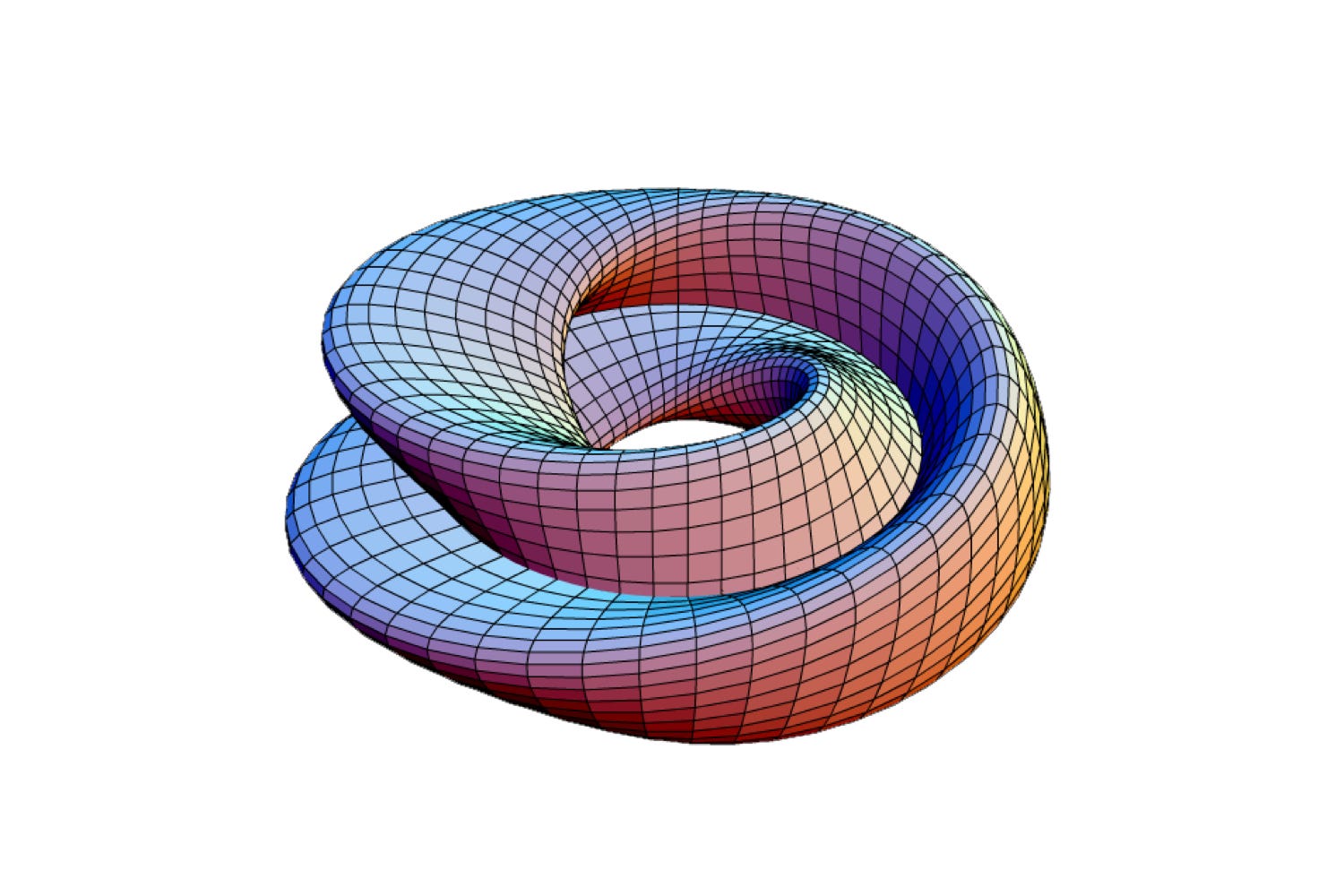
A manifold describes a space that cannot be governed by a single global coordinate system. Multiple dimensions interact continuously, and relationships change with position and scale. What feels locally navigable does not resolve into a stable global picture.
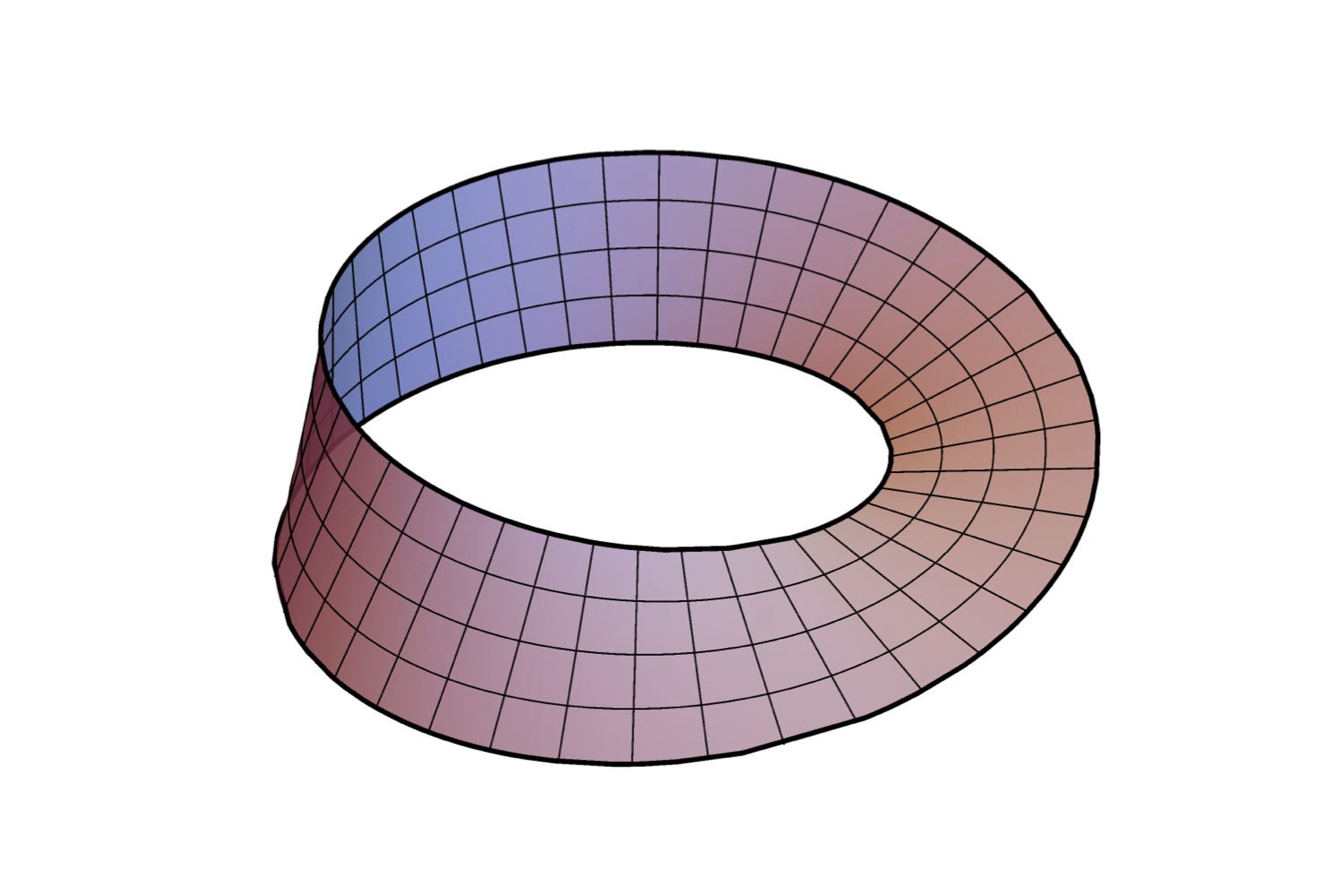
Topology offers a helpful intuition. A Möbius strip is a two-dimensional compact manifold with a single continuous surface. What appears locally as an inside and an outside turns out, through traversal, to belong to one uninterrupted plane. Orientation flips through movement, and the structure cannot be grasped from any single vantage point. It becomes legible only through local charts and the transitions between them.
Maps provide a more everyday analogy. A flat map is a useful abstraction. It helps you get around within defined limits. But treated as a complete representation of the terrain, it distorts distance, scale, and relation. A manifold model corresponds more closely to the terrain itself, shaped by curvature, gradients, and hidden paths.
Strategy is often described as navigation, as the ability to read terrain and choose direction under uncertainty. That analogy still holds. But the terrain has changed as we are no longer navigating physical space, nor stable organizational or market landscapes. Strategy needs to capture a multidimensional social, technological, and economic space shaped by media systems, neural technologies, and collective meaning-making.
In the transition from networked to neural media, and from organizational to community-driven production of meaning, this space becomes continuous, nonlinear, and path dependent. Actions taken in one domain bend conditions in others. Position matters less than orientation.
The strategic value of manifold thinking lies in its ability to better model the terrain and stay aligned with its dynamics, while holding together three properties that contemporary strategy increasingly demands: continuous variation instead of fixed categories, nonlinear interaction where changes in one domain reshape the effects of others, and path dependence where past trajectories shape which futures are reachable.
This aligns closely with how complexity science understands complex adaptive systems. In that tradition, systems are continuous rather than discrete, nonlinear rather than additive, and historically conditioned rather than freely configurable. Manifold thinking provides a spatial intuition for these dynamics by translating abstract system behavior into navigable terrain.
Applied to culture, media, and technology, a manifold perspective reveals a warped, multidimensional space formed by overlapping processes of meaning-making, technological change, and social organization. What appears coherent from one position may dissolve or invert from another.
From media separation to multimodal entanglement
A longer historical view helps put these developments into context. For much of modern history, media formats aligned neatly with specific technologies. Production pipelines were segmented. Cultural and media institutions, professional roles, and creative identities formed around these separations and were reinforced by them.
Human culture itself, however, has always behaved differently. As Benjamin Bratton has noted, culture functions more like a manifold, a river from which individual expressions briefly surface before rejoining the flow. What is changing now is not culture’s underlying nature, but our technical relationship to it. Large language models and multimodal systems begin to operate across representations and, as Bratton puts it, “you put in a song, you get out a picture, you put in a novel, you get out a robot instruction, whatever.”. The boundaries hold just long enough to dissolve again.
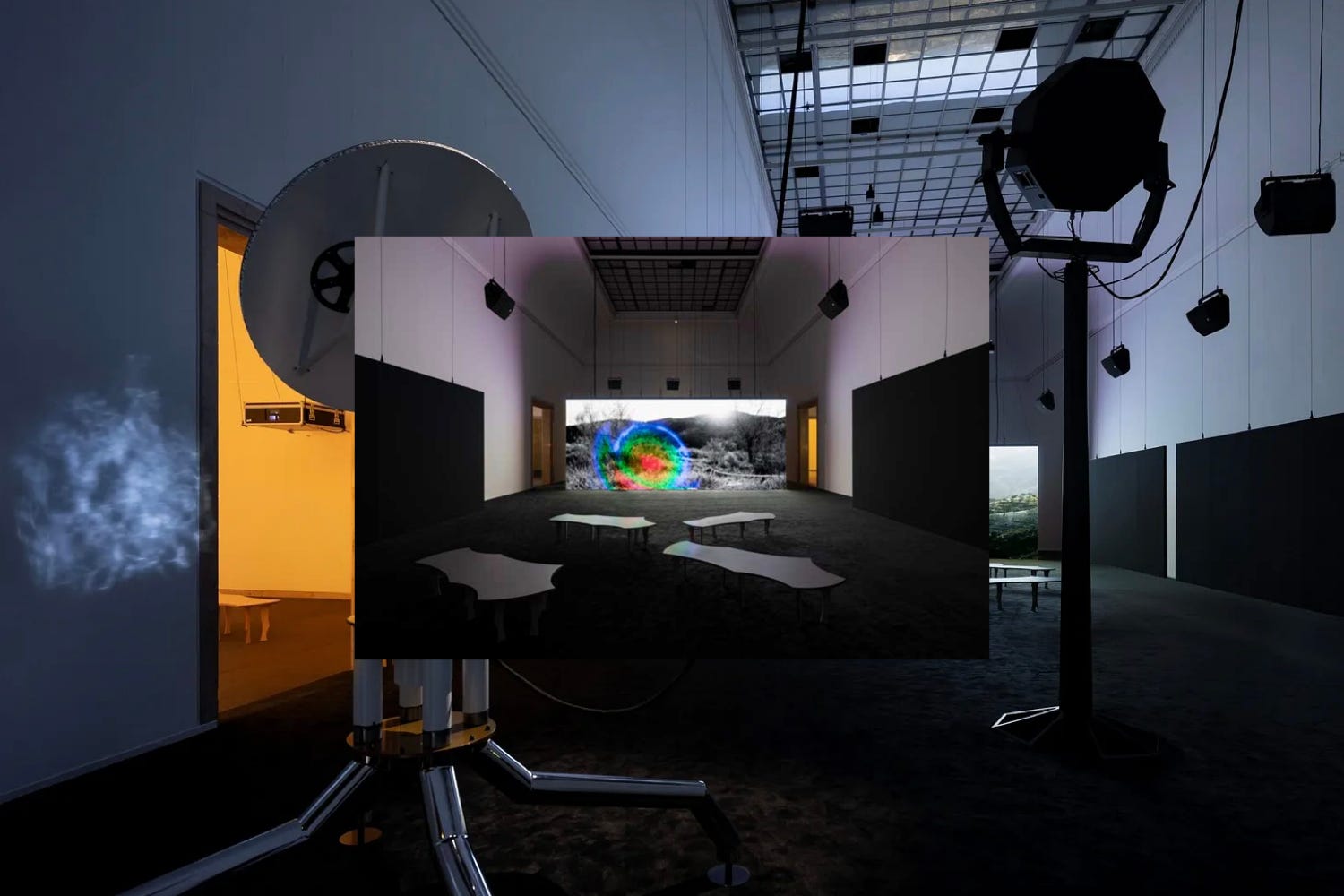
Emerging technologies increasingly reshape how media materials relate to one another, in ways that begin to mirror how culture has always functioned in practice. Works, authors, and products appear as temporary consolidations and interdependent smaller elements within broader cultural flows.
Many media theories and business models still assume discreteness. They rely on stable objects, bounded formats, and linear production processes. Under manifold conditions, these assumptions begin to fail. They obscure how meaning, participation, and value now move across media, mutate through use, and accumulate over time rather than at the moment of release.
What unfolds first within cultural and media sectors doesn’t stay there. These fields surface structural shifts early. As other industries encounter similar entanglements of technology, participation, and meaning, the need for models that accommodate continuous variation, nonlinear change, and emergent trajectories becomes urgent.
The innovation trap: new tech, old meanings
Much of the current discussion around AI and innovation in media and culture feels stuck. Attention fixates on faster production, cheaper workflows, and smoother pipelines. The rhetoric is transformational but the outcomes are reassuringly familiar.
This pattern closely mirrors the innovation dynamic identified by Roberto Verganti in his work on design-driven innovation in 2009. Verganti argued that innovation unfolds along two largely independent dimensions: technological change and meaning change. His central insight still stings. Breakthrough innovation rarely comes from technological novelty alone, but from shifts in how objects, practices, and roles are understood.
The same diagnostic applies here. Innovation in culture and media can be mapped over two axes: shifts in means, and shifts in meaning.
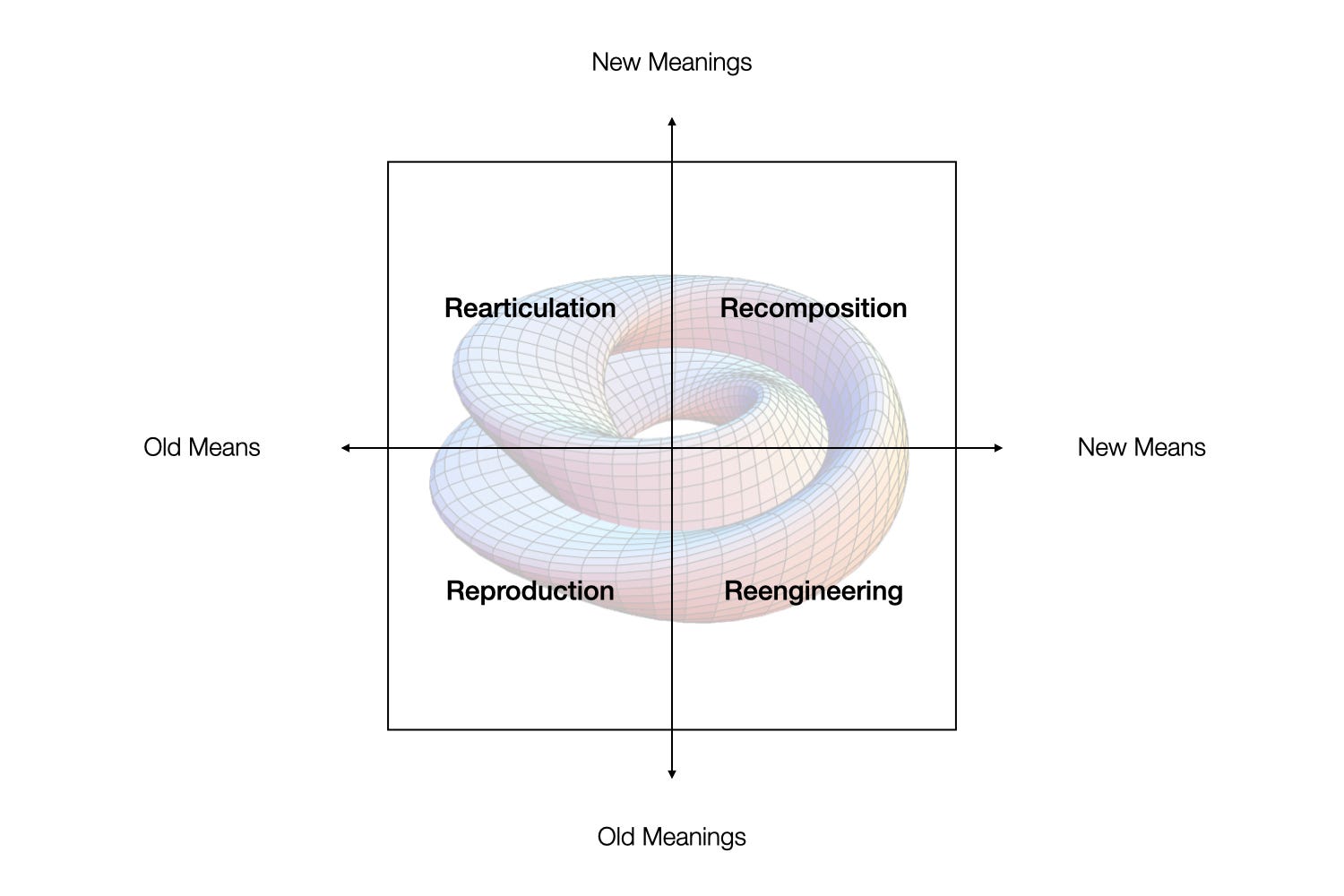
Means refer to the technologies, processes, tools, and infrastructures through which culture is produced, circulated, and experienced. Meanings concern the social processes of how ideas, value and relevance are constructed and sustained. Means evolve now quickly. Meanings can be more stubborn. They linger in institutions, habits, funding models, formats, and professional identities long after the tools have changed.
A simple 2x2 matrix offers a deliberately blunt way to read this terrain. It sketches four broad modes of cultural change.
Reproduction: Maintaining established forms and institutional continuity.
Reengineering: Applying new technologies within inherited purposes and formats.
Rearticulation: Shifting meanings while largely retaining existing technologies.
Recomposition: Re-aligning meaning, participation, and capabilities together.
Across media, culture, and the creative industries, many are busy reproducing the past, while most AI-driven experimentation stays stuck in reengineering. When the means change but meanings don’t, films still act like films. Books like books. Songs like songs. Exhibitions like exhibitions.
The quadrant where new means and new meanings emerge together is mostly empty. This is where inherited formats break and optimization stops helping.
Yet this is also where the most consequential transformations tend to unfold. Here, innovation becomes a matter of movement, orientation, and composition within a space that is actively shifting beneath one’s feet.
The emerging media and culture manifold
Expanding the 2×2 innovation matrix offers a higher-resolution view of the terrain. Even a modest move into additional dimensions begins to reveal internal variation, directional drift, and trajectories that remain invisible at lower resolution.
The 2×2 sketches broad tendencies. The 3×3 below shows how different modes of cultural production actually take shape within those tendencies. From a manifold perspective, grids still matter, but only locally. They function as provisional coordinates and design tools inside an approximate space, not as total maps of the territory.
In this sense, the matrix behaves like a field guide rather than a blueprint. Useful, orienting, and inevitably incomplete.
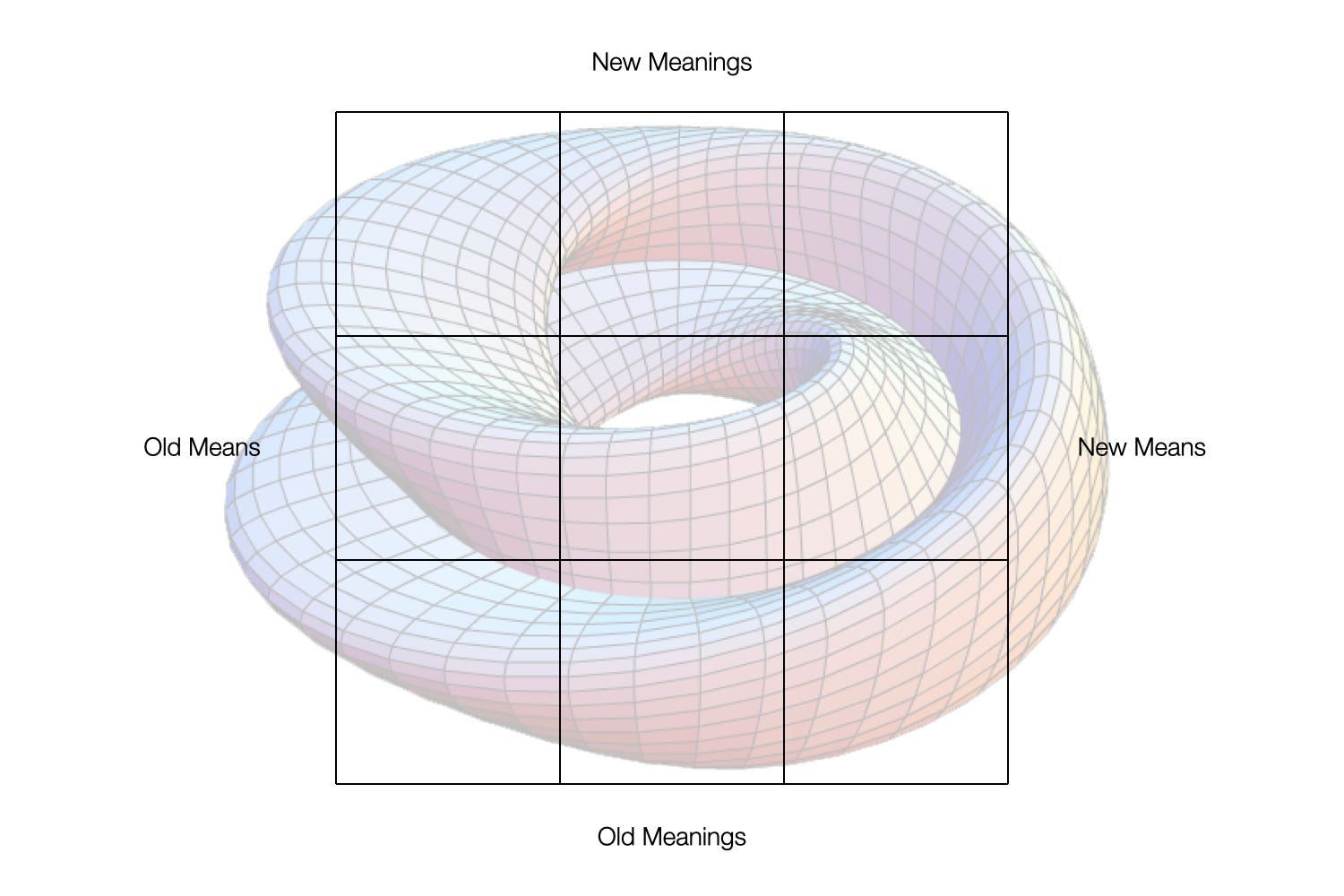
The vertical dimension concerns the social generation of meaning. Meaning in culture is never purely individual. It is produced, sustained, and transformed through social arrangements of authorship, participation, and recognition.
One way to understand how new meanings emerge is through the growing complexity of social processes of meaning-making and cultural production. As outlined in Three Eras of World Generation: Worldbuilding, Worlding, World-Weaving in Autonomous Worlds N1, three recurring formations appear across recent decades.
First, singular authorship, where meaning coheres around individual figures. Second, organizational authorship, where institutions coordinate production and legitimacy. Third, hybrid configurations in which authors, organizations, and communities act together. Each formation shapes how meaning forms, how participation is structured, how legitimacy is established, and how value accumulates over time.
The horizontal dimension concerns media and technological regimes. Following the taxonomy proposed by K Allado-McDowell, we can broadly identify three recurring regimes that matter here.
Broadcast media encompasses print and analog formats such as books, television, and radio. Networked media centers on platforms, circulation, and participatory flows. Neural media is built on generative models and multimodal interfaces, where distinctions between input and output begin to blur.
Each regime enables distinct patterns of circulation, mutation, and value creation. In combination with shifting social configurations of meaning-making, they shape how cultural worlds form, expand, stabilize, or dissolve across the manifold.
Recomposing new cultural worlds
Cultural worlds emerge across all regions of the manifold. What varies is how meaning is composed, who participates in shaping it, how it persists over time, and how value is organized. Each domain reflects a loose configuration of authorship and media regime, and a corresponding mode of world generation.
The manifold presented here is not a universal map. Different parameters, axes, or resolutions would yield different topologies and different opportunities. What matters is not the particular grid, but the shift it enables: away from static categories and toward a space defined by continuous variation, movement, and relation.
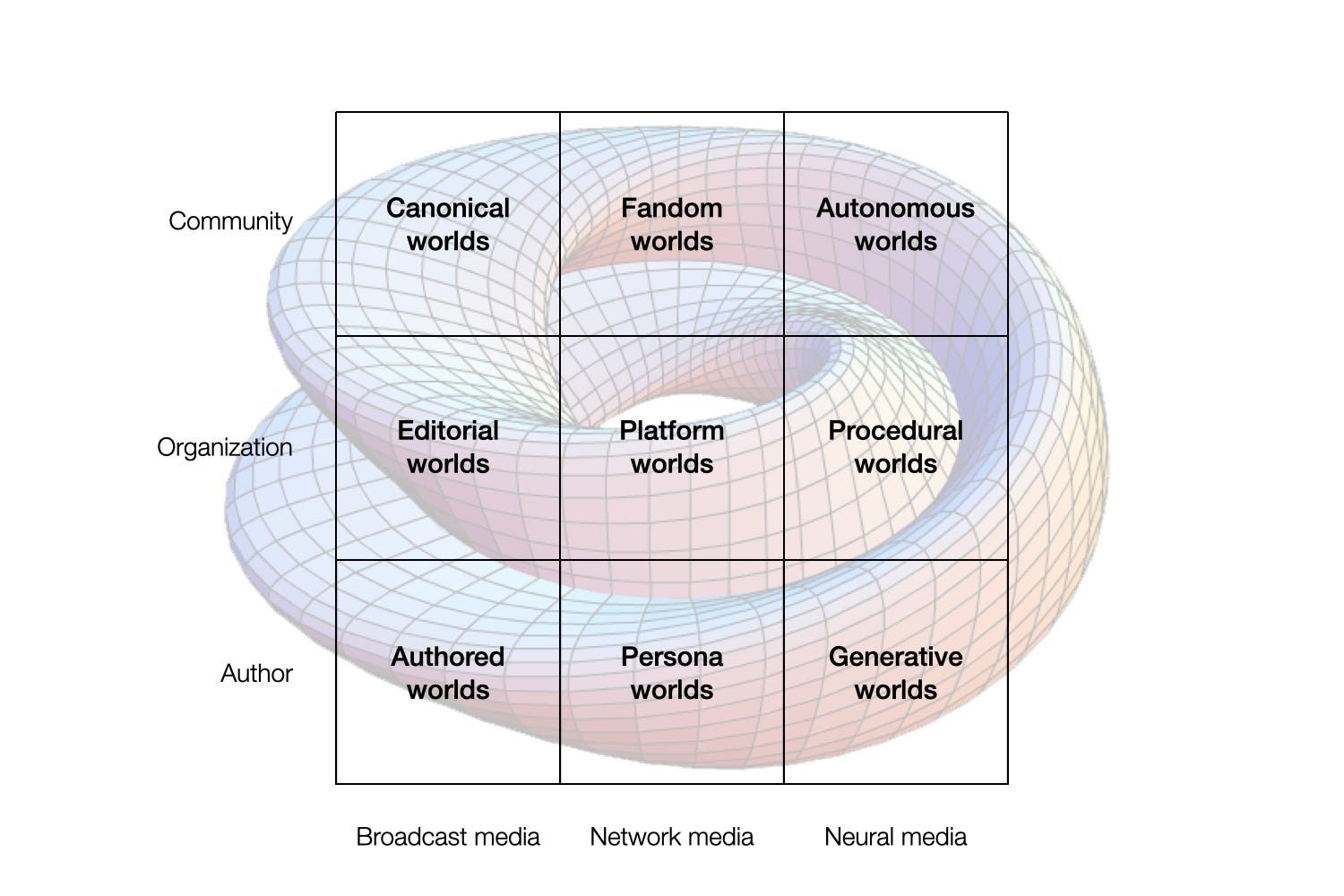
What follows is a selective exploration of nine such domains. The descriptions are intentionally schematic. Prototypical forms point to dominant organizational patterns of world production, not to fixed genres, specific platforms, or singular actors.
1 Author × Broadcast = Authored worlds
Worlds are generated through inscription by a singular author. Meaning is concentrated, bounded, and internally coherent. These worlds arrive as finished and stable forms. Participation takes place through interpretation.
Value is tied to ownership, scarcity, and authority. Media operates as a product, sustained through sales, rights, and long arcs of recognition.
Prototypical form: the novel, the photograph, the song.
2 Organization × Broadcast = Editorial worlds
Worlds are generated through organizational and institutional curation. Meaning emerges from selection, framing, and sequencing rather than from a single voice. These worlds evolve periodically through issues, seasons, or programs, bounded by editorial authority. Participation is indirect and mediated.
Media stays product-based but extends toward service through subscriptions, advertising, sponsorships, and institutional continuity.
Prototypical form: the exhibition, the magazine, the TV series.
3 Community × Broadcast = Canonical worlds
Worlds are generated through legitimation and preservation. Institutions stabilize meaning over long durations. Change is slow, accumulative, and mediated. Communities participate through recognition with little co-creation.
Value functions as a public or semi-public good. Funding relies on public support, philanthropy, endowments, and indirect market mechanisms.
Prototypical form: the museum collection, the public broadcaster programming.
4 Author × Network = Persona worlds
Worlds are generated through continuous presence within networked media, and persist as long as attention and participation continue. Meaning unfolds over time through voice, repetition, and vibes instead of discrete works.
Value flows through attention, patronage, subscriptions, and partnerships. Media manifests platform dynamics, tethered to a person or account.
Prototypical form: the influencer feed, the meme account.
5 Organization × Network = Platform worlds
Worlds are generated through systems and platform affordances. Organizations design environments within which meaning emerges through use, play, and modification. These worlds are permanently unfinished and evolve through participation.
Media operates as infrastructure and service. Revenue flows through access, marketplaces, add-ons, and ecosystem participation, often supported by licensing-based IP models.
Prototypical form: the production studio, such as A24 operating as a networked cultural platform; the sandbox game, such as Minecraft expanding within and across platforms.
6 Community × Network = Fandom worlds
Worlds are generated collectively through remix, response, and shared reference. Canon loosens and expands sideways through accumulation. Participation sustains coherence and continuity.
Value circulates indirectly through attention, platform dynamics, adjacent markets, and social capital rather than through ownership of works.
Prototypical form: the fictional fan canon, such as Harry Potter romantasy fanfiction; the idol fan canon, such as K-pop alternate universes and idol mythologies.
7 Author × Neural = Generative worlds
Worlds are generated through orchestration of possibility spaces. The author designs datasets, prompts, and constraints for generation. Each instantiation differs while remaining recognizably part of the same world.
Value attaches to authorship, curatorial control, and conceptual coherence. Media as a variable artifact, circulating through exhibitions and editions.
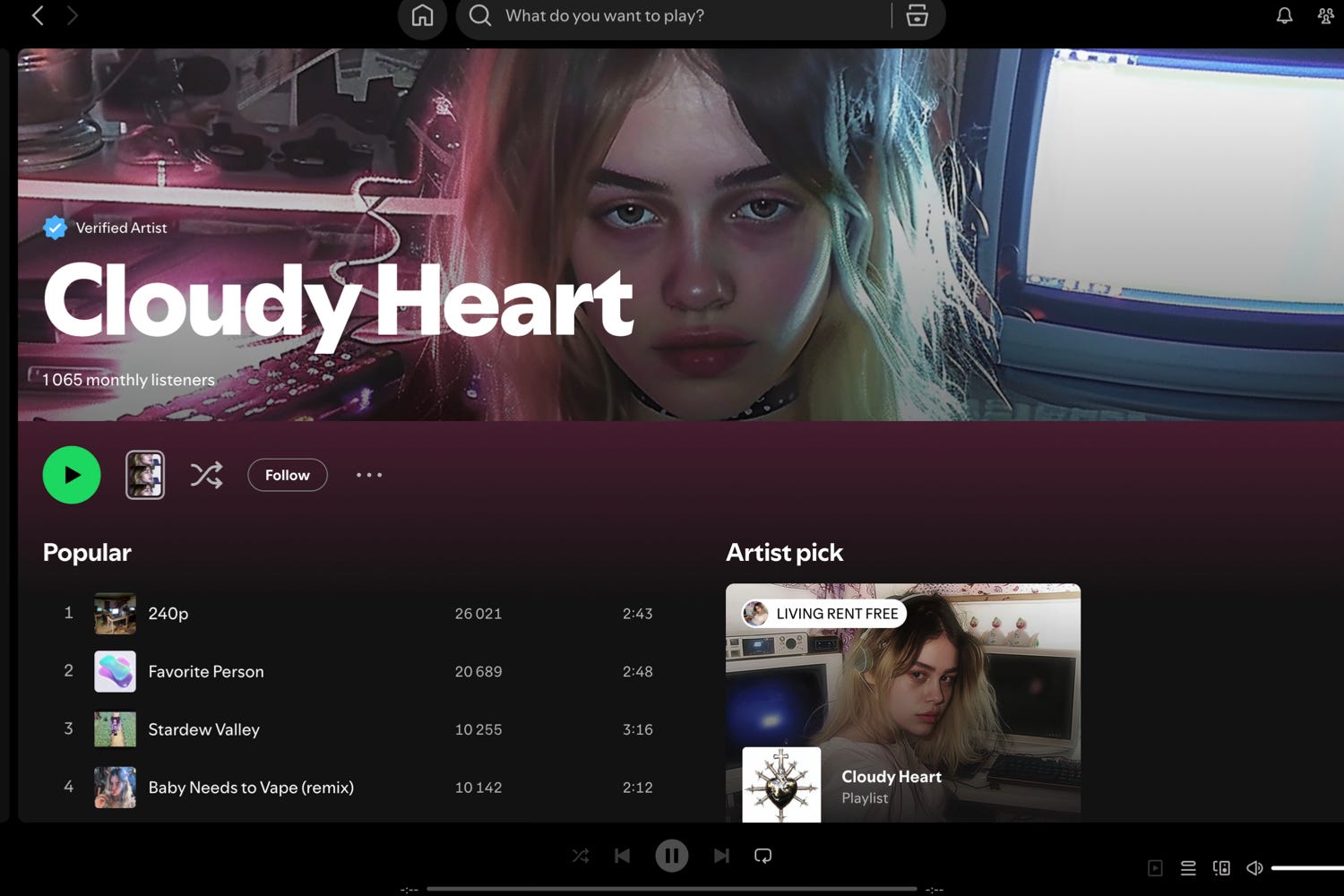
Prototypical form: the generative artwork, such as Jon Rafman’s Proof of Concept, MSN, and Cloudy Heart, which together unfold across thousands of files, formats, posts, and fragments.
8 Organization × Neural = Procedural worlds
Worlds are generated procedurally through models, pipelines, and constraints maintained by organizations. Output appears as continuous families of related expressions. Participation is limited and shaped by system design.
Value derives from procedural capacity, scalability, and brand coherence. Media as a living catalogue or production line.
Prototypical form: the generative series, such as the ultra-short Chinese AI video series Strange Mirror of the Mountains and Seas, where a continuous stream of variations accumulates into a storyworld.
9 Community × Neural = Autonomous worlds
Worlds are generated through recursive feedback between communities, generative systems, agents, and economic mechanisms. Meaning, identity, and value co-evolve. Control is distributed, and mutation sustains persistence. Participation is infrastructural and constitutive of the world itself.
Media increasingly operates like finance. Tokens, speculative value, memetic capital, and shared ownership intertwine. These worlds persist through recombination and ongoing unfolding.
Prototypical form: the online entity, such as Remilia Corp, calling itself a “self-organization, a lifestyle brand, a master-planned community, an investment fund, an artist’s colony, a crowdfunded video game, an autonomous smart contract, an independent record label, a manifesto, an institution.”
How to make sense on shifting ground
New domains don’t arrive as coherent systems, but they show up as fragments, partial structures, and competing narratives. The usual instinct is to stabilize them quickly. Manifold thinking asks you to wait, move, and make sense first.
Strategic manifold thinking can be understood as a way of entering new domains. It begins before frameworks, categories, or positions are fixed, at the moment you encounter unfamiliar terrain and need to make sense of it in order to decide direction.
You can begin by holding in mind the following seven orientations:
Start with movement, not definition. Rather than asking what a space is, attend to what is moving within it. Track shifts in attention, language, tools, norms, capital, and participation. These movements reveal the shape of the terrain long before labels or categories stabilize. In a manifold, structure emerges through change.
Think in paths, not positions. Actors, ideas, and practices are not fixed points. They are trajectories. What matters is how something arrived, what it is adjacent to, and where it appears to be drifting. Early insight comes from seeing paths while others are still debating positions.
Zoom locally and distrust the global picture. Manifolds are locally legible and globally strange. Small slices of a domain often make sense on their own, while attempts at total overview tend to flatten or distort the space. Focus on concrete instances: a tool, a workflow, a community, a meme. Let the larger pattern assemble itself from accumulated local readings rather than forcing a top-down map.
Look for gradients instead of categories. Categories describe what already exists, while gradients point to what is forming. Notice where intensity increases or fades, where things accelerate, slow down, thicken, or thin out. Gradients show where pressure is building and where new forms are likely to emerge.
Treat confusion as signal. In manifold space, inconsistency is not a bug but a feature. When things feel contradictory or unstable, the space is folding. Tension should not be resolved too quickly. Disorientation becomes data. Pay attention to where it appears and what it clusters around.
Move experimentally. Manifolds cannot be understood from a distance. Engage the space directly. Test, publish, prototype, participate. Speak with edges rather than centers. Sensemaking sharpens through action. Understanding follows movement, not the other way around.
Optimize for orientation, not certainty. The goal is not a stable model of a moving world, rather the ability to remain oriented as conditions change. Manifold thinking does not aim to predict outcomes. In continuous space, staying navigable longer than others becomes a strategic advantage.
New episteme for a manifold world
As innovation unfolds through movement toward new meanings, it requires a broader episteme.
Analytical modes of knowing remain indispensable. They clarify structure, systems, and organization. But on their own, they tend to flatten a world that increasingly behaves dynamically. They favor categories over trajectories, snapshots over movement, and stability over change.
More experiential modes of knowing therefore become equally necessary. They register change as it happens, through shifts in meaning, value, participation, and relation that resist capture by static abstractions. Taken together, these registers make it possible to understand change across media, culture, and technology without collapsing it into generic claims or managerial shorthand.
I have referred to this experiential register as night language. It attends to multiplicity, atmospheres, relations, and dynamics. It surfaces patterns that emerge through interaction, embodiment, and use rather than through classification alone. These ways of knowing are not new. They are well established in philosophy, the social sciences, and artistic and design research, even if they are often sidelined in strategic contexts.
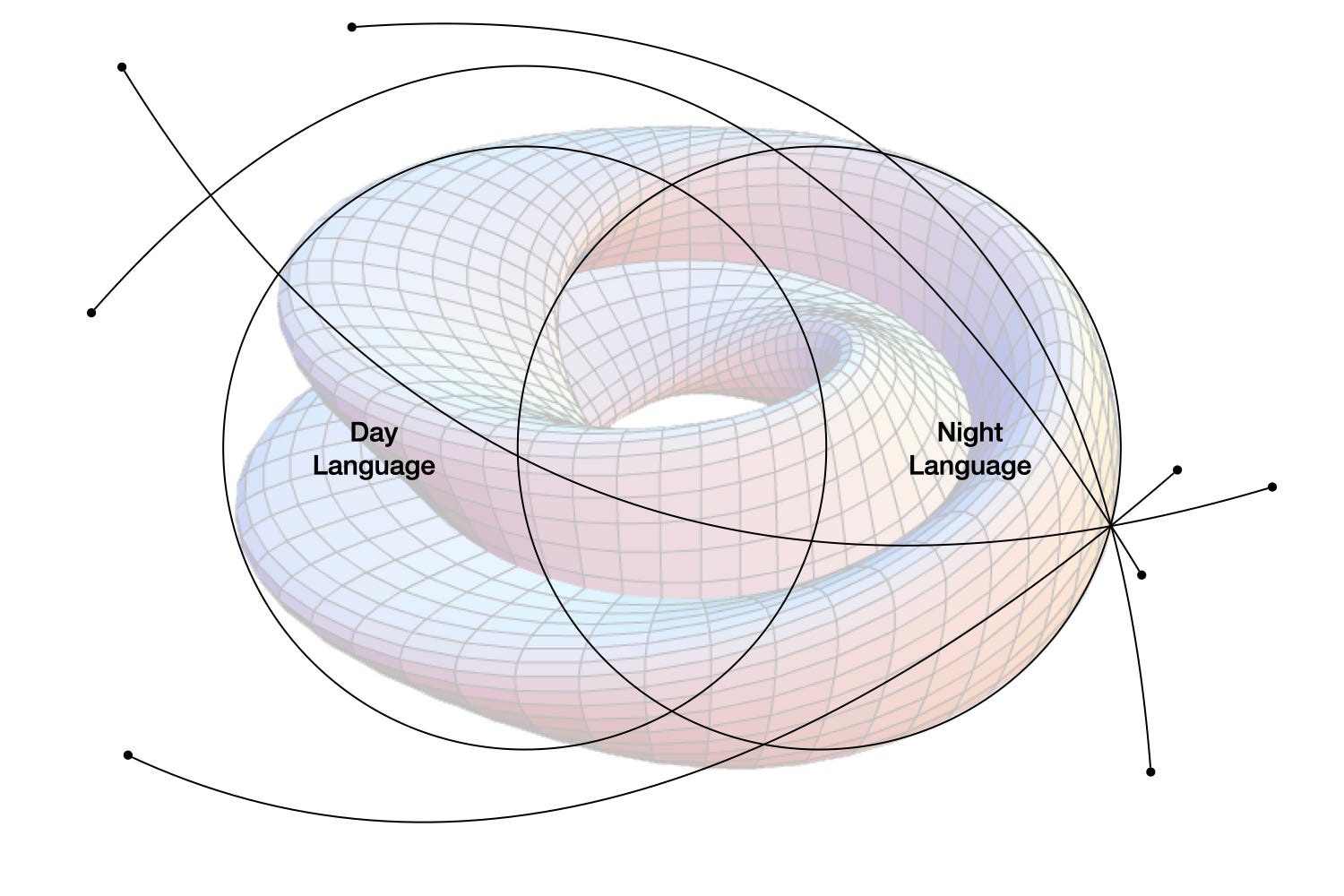
Instead of fixed positions or stable categories, cultural formations and meanings appear here as temporary configurations. They drift, cluster, stabilize, and dissolve over time in ways that analytical day language struggles to keep in view.
Night language aligns closely with manifold thinking. It is sensitive to nonlinear interaction between dimensions and to path dependent movement through cultural and technological space. It assumes continuous variation rather than discrete states, and treats understanding not as a final position, but as something that must move with the terrain.
Learning to move without a map
Culture and media now operate on a terrain that bends and folds as we move through it. Meaning, participation, identity, value, and opportunity drift and collide along paths shaped by what came before. Neural and generative technologies intensify this condition, expanding and reshaping the space faster than institutional, business, and brand strategies can reasonably map it.
The manifold strategy shifts attention from fixed categories to trajectories, from positions to paths, and from finished forms to ongoing worlds. Strategy becomes a practice of sensemaking in motion. Models still matter as local charts. Direction comes from the ability to move across domains, recognize adjacent opportunity, and engage emerging possibilities while they are still forming.
The next phase is already visible. Cultural institutions become infrastructure for generating and sustaining worlds. Brands move from campaigns to long-arc participation in cultural systems. Media organizations shift from producing outputs to designing worlds, protocols, and narratives that grow with their communities.
The challenge is the same across the board. Stop optimizing inherited categories. Build the manifold capacity to read the terrain, move with it, adapt in real time, and stay relevant in a cultural and media landscape that keeps getting weirder.