

McKinsey Meets Berghain
Why strategy in 2026 needs two languages

The big idea in strategy for 2026: weave together McKinsey with Berghain
If we want to understand what is really happening in this polycrisis and identify opportunities for work that is valuable and meaningful, we must rethink and update how knowledge is produced inside organizations.
(This is also the key to learning how to work with expanding machine intelligence instead of trying to out-compute it. But more about that later.)
Most organizations still operate almost entirely in McKinsey mode. Linear reasoning, backward-looking learning, strategic frameworks, metrics, and dashboards. PowerPoint logic as the primary way of making decisions. It is powerful, but it is only half the story.
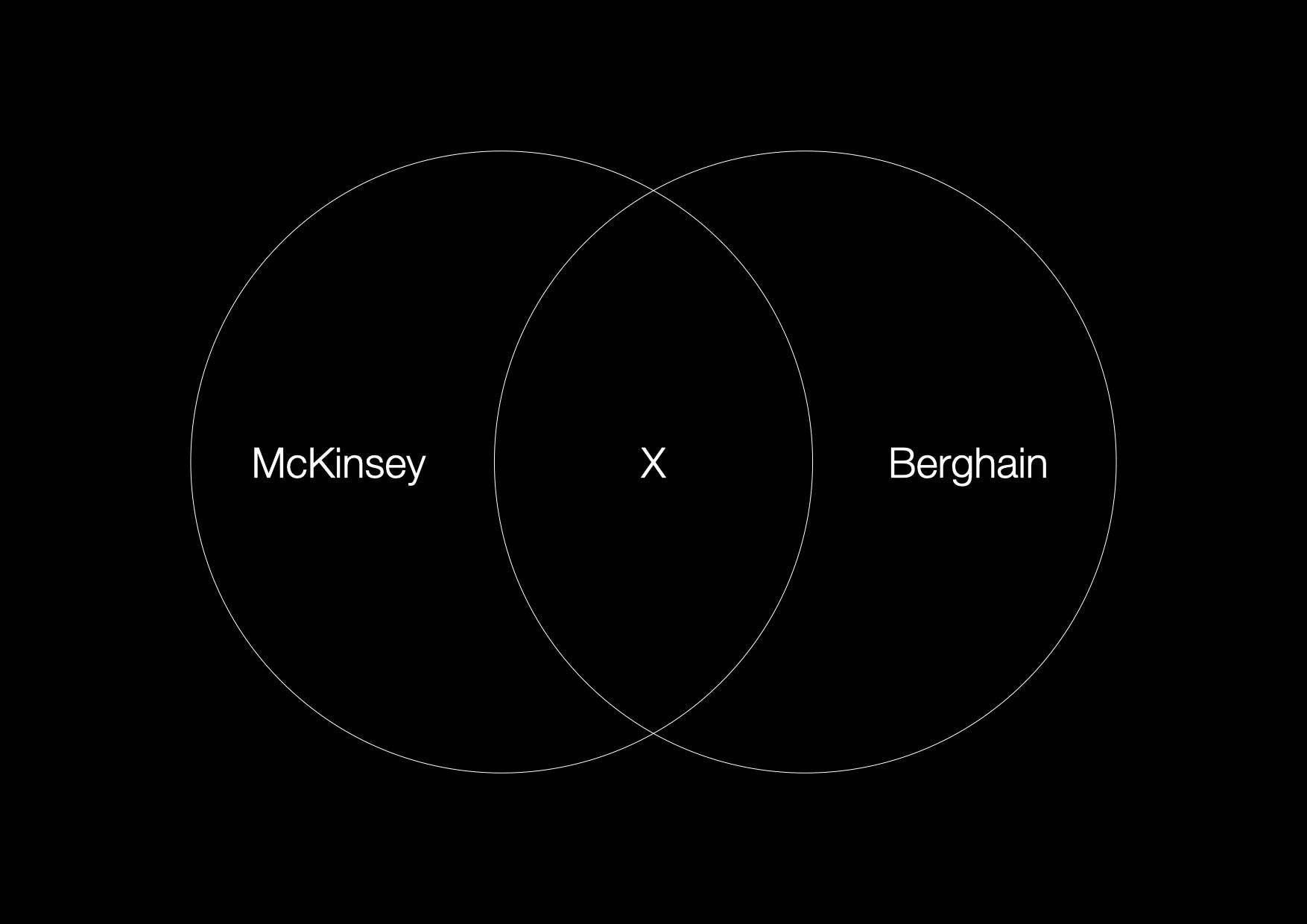
The missing half is what I call the Berghain side of strategy. Berghain is not a nightclub. It is an institution of contemporary culture, a site of long-form immersion, collective intensity, and altered perception.
It functions as a myth of the nocturnal world and points to a way of knowing that is tactile, relational, and dialogical. It learns through immersion, play, artistic practice, cultural sensemaking, philosophical inquiry, and embodied experience.
It is comfortable with abductive leaps, not only business as usual, optimization, innovation, and prediction.
This epistemic tension is not new. The existentialists were already wrestling with it after the Second World War, when familiar systems of meaning collapsed.
A framing I often return to comes from Finnish scholar of existential philosophy Torsti Lehtinen, who distinguishes between two complementary languages for engaging with reality:
“To make sense of life, we need two different languages. The day language is the language of controlling reality, and the night language is the language that kneels before mystery.”
Day language and night language
The McKinsey side lives in day language. It explains, measures, and structures. It uses numbers, models, and logic to define the visible world and support deliberate decisions.
The Berghain side lives in night language. It is the language of art, poetry, culture and experience. It stays with complexity instead of trying to tame it. It tunes into atmospheres and emerging meanings. It helps us perceive the world in higher resolution through new metaphors, deeper insights, and experimental models that surface what has not yet been formalized.
The work ahead is about learning to weave these modes of knowing together. Combining the daylight logic of the corner office with the nocturnal sensibility of the club.
Depending on the strategic question, they should interweave in everything, from how insights are gathered to how futures are reimagined, narratives reframed, possibilities redefined, and decisions made.
(If you want a literal sense of what this night language feels like in its native context, read Prosessi by Klaus Maunuksela. It is available in Finnish only though. The book traces the burning, fleeting experience of a night in Berghain and the tacit, embodied ways we make sense of moments before they slip away, and the underlying processes that shape that knowing.)
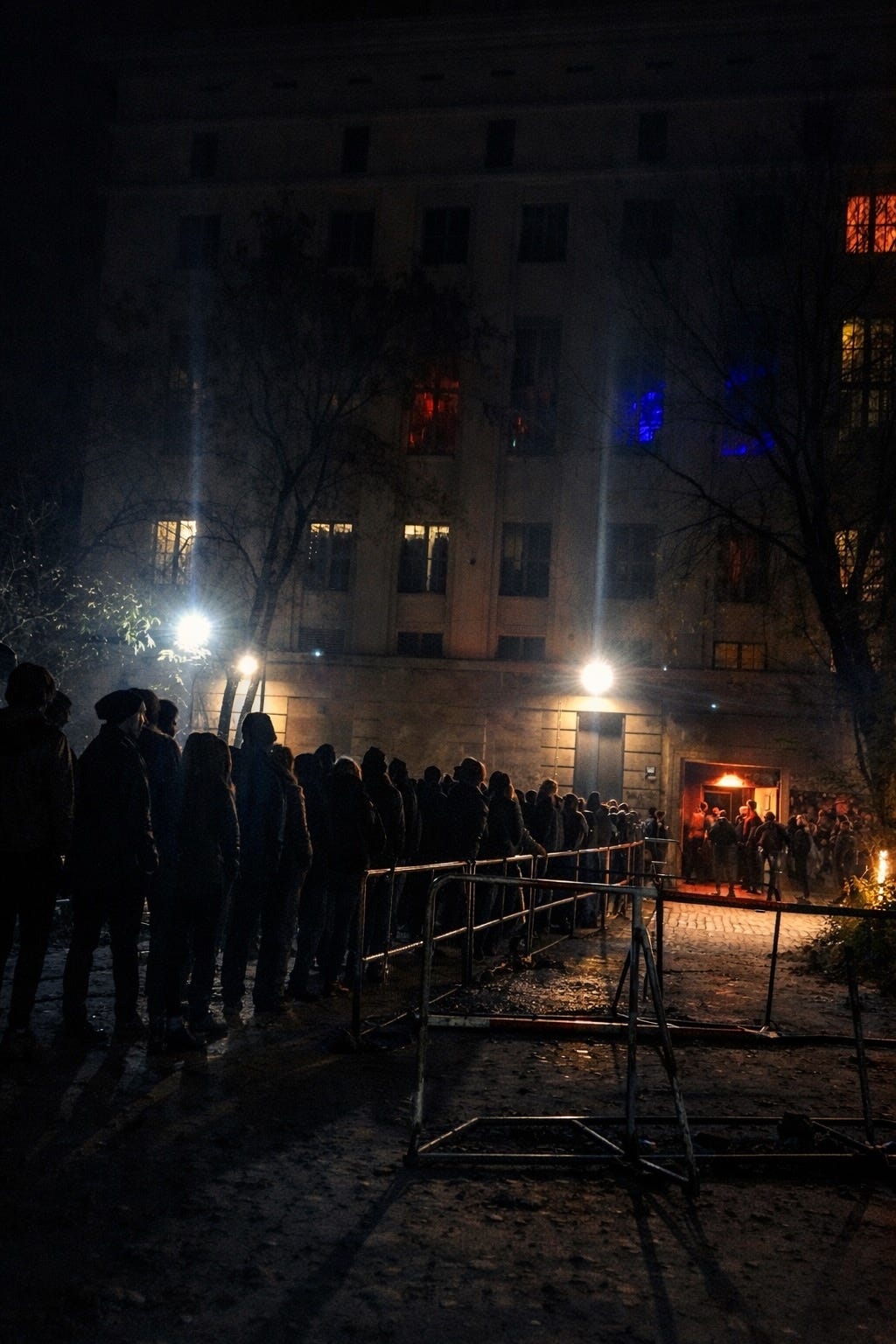
Into the night.
Why strategy needs night language
The corner office still runs mostly on day language. Control, targets, steering from a distance.
This logic is rooted in cybernetics. In the mid-twentieth century, cybernetics was developed as the science of feedback and control. You set a target, measure deviation, and correct course. Thermostats, autopilots, management by KPIs.
This works for simple and stable systems. But these are not simple or stable times.
Technology now acts with agency. Markets behave like cultural systems. Meaning shifts. Planetary limits are real. Value is created across messy networks. By the time metrics stabilize, reality has already moved.
Strategy therefore needs to function less as a planning cycle and more as an organizational capability for rapid adaptation, a way of preparing for even stranger times ahead.
Night language in action
A useful reference point for this shift comes from the Antikythera research program on planetary computation. You could see it as an attempt to rebuild cybernetics for the 21st century and beyond.
Their work reframes intelligence as something that does not only predict and optimize, but co-evolves with human and technological systems. Computation becomes about orientation as much as control. It helps us understand where we are inside complexity, not only where we want to go.
Translated into strategy, this implies a few fundamental shifts:
From control to orientation. Day language wants fixed targets. Night language helps you sense when the terrain itself is changing and direction must be retuned.
From foresight to sensemaking. Day language tries to forecast. Night language reads weak signals in culture, behavior, language, and networks before they harden into trends.
From optimization to co-evolution. Day language perfects what already exists. Night language allows you to evolve with customers, partners, and communities in real time and to step into new territories.
This is strategic night language in practice. Humility in front of the mysteries of life, a way to learn to dance with complexity.
Two strategic languages for weird times
To make sense of the world ahead, strategy needs to become bilingual.
The McKinsey style day language is the language of control. It is what allows us to engineer bridges, set priorities, allocate resources, and make things work at scale.
The Berghain style night language is the language of attention and attunement. It is what allows us to notice when the ground is shifting, when meaning is changing, and when new possibilities are emerging before they can be named.
One without the other produces either brittle systems or beautiful confusion.
In 2026, serious leadership is about learning to move between rigor and mystery, and knowing when the moment calls for light and when it calls for darkness.